
Dog Years to Human Years: Methods Compared
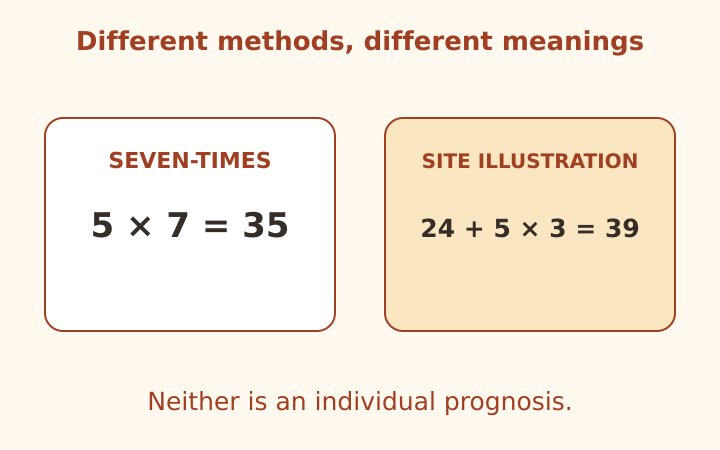
Converting dog years to human years is a comparison method, not a direct measurement shared by two species. The familiar seven-times rule, a staged illustration and a research formula can return different numbers because they represent different assumptions or questions. This guide compares those approaches without declaring a calculator result to be an individual’s biological age. PawAgeCalc uses one transparent illustration and keeps chronological age visible, rather than presenting several unrelated outputs as interchangeable clinical answers.
Start with the quantity that is actually recorded
A dog’s chronological age is elapsed time since birth. If the birthday is documented, a calendar calculation can report that age as of a chosen date. If the birthday is estimated, the chronological result inherits that uncertainty. This record is distinct from every attempt to describe the age in human-year language.
Human-year equivalents add a model between the original age and the displayed number. A model may use a fixed multiplier, a staged arithmetic rule or a relationship derived from particular biological measurements. Before comparing outputs, identify that model. Two numbers can disagree even when both calculators have applied their stated formulas correctly.
A useful comparison note therefore contains dog age, reference date when relevant, model and assumptions. An isolated statement such as forty-nine human years loses the information needed to interpret it. Keep the underlying dog age beside the comparison, especially when the number will be shared in a profile, family conversation or record.
Examine what the seven-times rule does
Multiplying a five-year age by seven gives thirty-five. Multiplying a ten-year age gives seventy. The rule is easy to perform and remember because every additional dog year produces the same seven-year change. It also treats every age and every dog alike unless further assumptions are added outside the formula.
That constant slope is the defining feature of the method. It does not separately represent early and later years, adult size, breed or an individual’s history. A neat multiplication result should not be mistaken for evidence that those factors have been evaluated. The formula only knows the original age and the chosen multiplier.
The UC Davis veterinary overview discusses why the simple seven-times comparison is limited. That context does not imply that replacing seven with another number automatically creates a validated biological scale. A more elaborate illustration still needs its scope explained, particularly when it is presented through an authoritative-looking interface.
Read PawAgeCalc’s staged illustration explicitly
The site’s comparison begins at fifteen at one dog year and twenty-four at two. Between those points it uses linear interpolation. After age two, the selected adult-size group adds four, five, six or seven illustrative human years for each dog year. Those post-two-year slopes and size boundaries are this site’s choices, not an official veterinary chart.
For a medium assumption at dog age five, the calculation is 24 plus 5 times 3, giving 39. At ten it is 24 plus 5 times 8, giving 64. The differences from the seven-times results are consequences of the starting points and slope. They do not establish that one fictional dog’s health resembles that of a human aged thirty-nine or sixty-four.
All groups share the initial comparison points
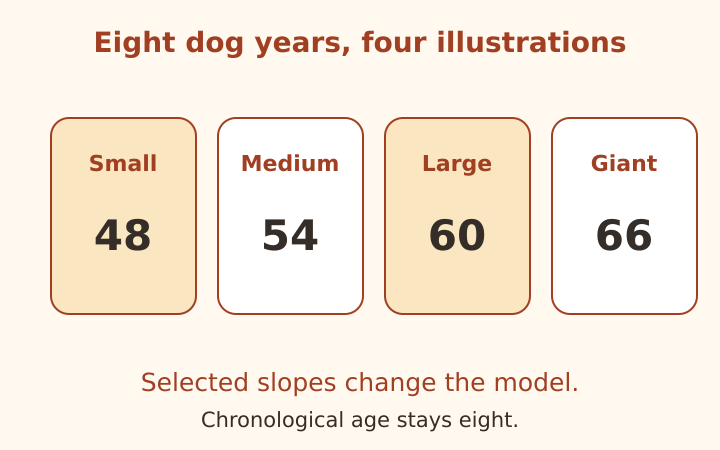
At dog age one and two, the site does not separate its size groups. At age five, the chosen slopes create small 36, medium 39, large 42 and giant 45. This table illustrates how an assumption affects an answer. It does not model every breed or imply that broad weight groups contain biologically identical dogs.
Distinguish a research translation from a simple chart
Wang and colleagues studied conserved DNA-methylation patterns in their dog-to-human ageing research. That work concerns a biological research relationship rather than a general birthday widget. It should not be treated as a universal individual assessment merely because a formula from the study can be typed into a web page.
The reported logarithmic relationship often described as 16 times the natural logarithm of dog age plus 31 produces 31 at age one. That differs from the fifteen-year point in the site’s staged illustration. The difference reflects a different method and research context. PawAgeCalc does not implement this logarithmic output or combine it with its size slopes.
A formula’s origin matters as much as its mathematical form. Research population, measurements and scope need to be understood before an output is generalized. A calculator accepting every breed name would not itself prove that the underlying study covered or validated every breed. Avoid using a research citation as decoration for a model that is actually different from the published method.
Compare methods at the same input and reference
If you want to compare methods arithmetically, keep the dog age fixed. Use five years for every calculation rather than five in one tool and five years six months in another. Keep the same size assumption where a method requires one. Changing the input and model together makes it difficult to explain why the answers differ.
Also compare rounding. A decimal result may be rounded to a whole number on one site and displayed with one decimal place on another. That presentation difference is separate from a model difference. Preserve the formula and unrounded input when examining a disagreement, instead of assuming that a more detailed display must be scientifically more accurate.
The worked age-chart examples show the arithmetic for this site with explicit assumptions. They can help reproduce a result without implying that the illustrative table is an official chart. Independent checks are useful precisely because the method is simple enough to inspect.
Keep human-year language away from individual prognosis
A converted number does not estimate how long a particular dog has left to live. It also does not determine a diagnosis, clinical life stage or care schedule. Those conclusions need information not included in the formula. The calculator’s size group and birthday do not substitute for a veterinary history or examination.
Population longevity research answers another question again. A study can describe patterns in a defined group without assigning a remaining-lifespan countdown to an individual. Do not subtract chronological age from a population figure and present the difference as a prediction. PawAgeCalc deliberately does not display a breed lifespan or a remaining-years field.
Use the dog age calculator as a transparent age note, with chronological age first and the illustration clearly labeled. Informational only, not veterinary advice. The comparison is most useful when a reader can see what it represents and recognize the questions it has not answered.
Frequently asked questions
Why do different calculators disagree?
They may use different starting points, slopes, interpolation, size assumptions or research models. Compare definitions before comparing numbers.
Does this tool use the logarithmic research formula?
No. It uses an explicitly illustrative staged model. A research translation is discussed as context rather than mixed into the site’s size slopes.
Keep age and assumptions together
Open the dog age calculator to make an age note with the entry method and adult-size assumption visible. The human-year comparison is illustrative only, not veterinary advice, a health assessment or a prediction of remaining lifespan.
More notes from the setup desk
Dog Age Chart: Five Clear Worked Examples
Follow five original age examples, including size comparisons, fractional ages, puppy dates and clearly labeled model extrapolation.
Read the note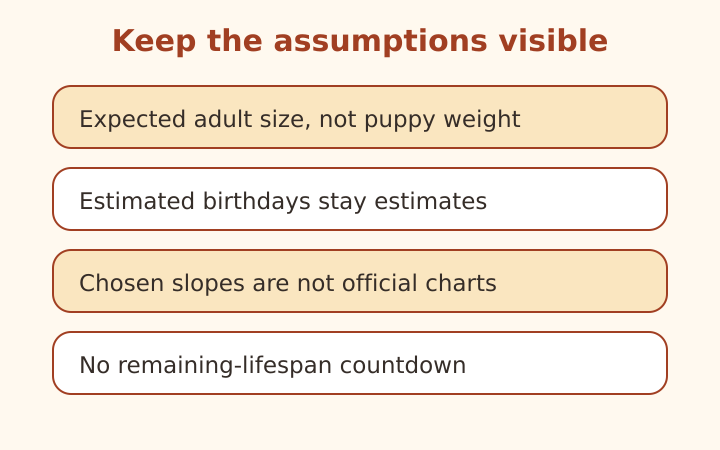
Dog Age by Breed and Size: Mistakes to Avoid
Check adult-size assumptions, estimated birthdays and chart claims. Learn why breed longevity statistics are not individual countdowns.
Read the note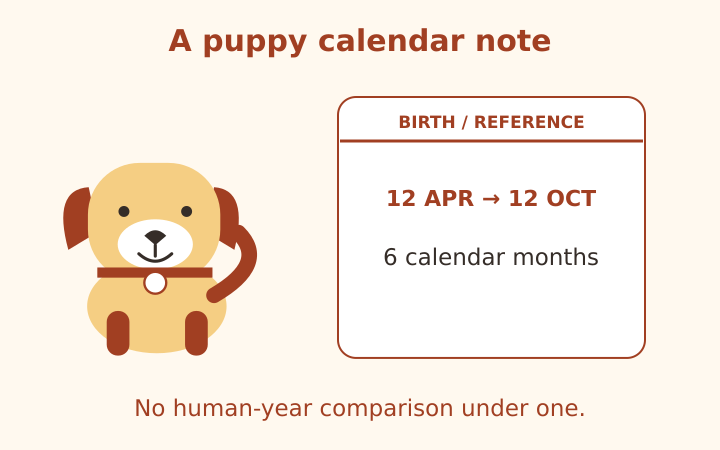
Puppy Age Calculator: Calendar Age Explained
Understand puppy calendar age, estimated birthdays, weeks versus months and leap-day conventions without a human-age assessment.
Read the note