
Dog Age by Breed and Size: Mistakes to Avoid
Searching for dog age by breed can suggest that every breed has one exact conversion factor. A large breed dog age calculator can create a similar impression if its assumptions stay hidden. PawAgeCalc instead uses broad, explicitly illustrative adult-size groups and does not infer a breed or lifespan. This checklist explains common input and interpretation mistakes so a size-based comparison does not become a claim about an individual dog’s health, development or remaining life.
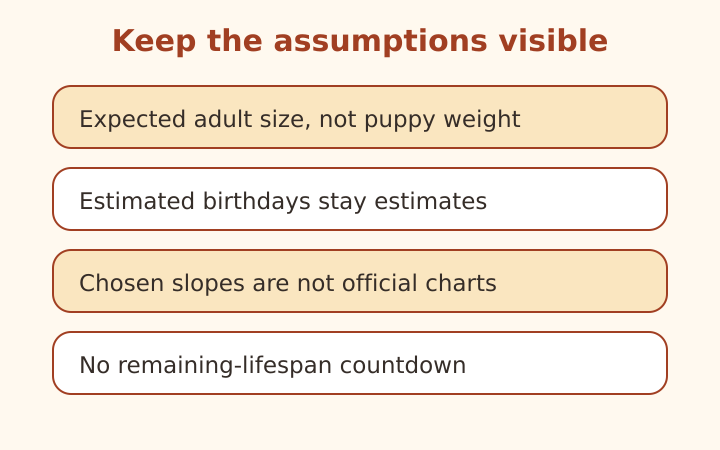
Do not substitute a puppy’s current weight for adult size
A small current weight can belong to a puppy that will become a much larger adult. If the model asks for expected adult size, current puppy weight answers a different question. The calculator does not estimate mature weight from a growth curve, breed name or photograph. Use a known expectation or choose Unknown when the adult group is uncertain.
The groups on this site are small under ten kilograms, medium from ten to under twenty-five, large from twenty-five to under forty and giant forty or more. These are software model boundaries, not veterinary standards. They control the illustrative slope after age two. Crossing a boundary changes the arithmetic, not the biological state of a dog at that exact weight.
If the expected adult size is uncertain near a boundary, compare adjacent groups as labeled scenarios. A five-year example gives 39 in the medium group and 42 in the large group. The three-year difference belongs to the selected assumptions. It is not an uncertainty interval validated for the individual, and the calculator cannot decide which group is appropriate from age alone.
Recognize what a breed label leaves unspecified
Breed names can provide context, but they do not supply all individual information relevant to ageing. The site does not store a breed database or claim that a name determines a unique biological pace. A broad adult-size choice is deliberately less specific than a breed forecast, and its limits should remain visible.
For a mixed-breed dog, an unknown pedigree does not prevent recording chronological age. Keep known facts such as a documented birthday distinct from an uncertain adult-size assumption. Do not invent a breed mix just to obtain a more elaborate-looking result. Unknown uses a labeled medium assumption here, allowing the arithmetic to continue without pretending that missing information has been recovered.
The McMillan and colleagues longevity study, together with its author correction, examines variation in a defined companion-dog population. It supports treating longevity as a research question with population context, not as a single guaranteed number for every dog sharing a label. PawAgeCalc does not turn that study into a breed-specific countdown.
Avoid treating chosen model slopes as official data
After age two, this site’s small, medium, large and giant groups add four, five, six and seven illustrative human years per dog year. The coefficients are visible choices for a simple comparison. They are not presented as an official AVMA or AAHA table, and the calculator does not claim that a dog in each group necessarily ages at that exact rate.
A common error is to attach a veterinary organization’s name to a simplified chart without preserving what the original source actually says. References on this site give context and limitations. They do not certify the site’s custom interpolation, weight boundaries or later-year slopes. Keep the phrase illustrative model with any shared result.
A changed group is a changed assumption
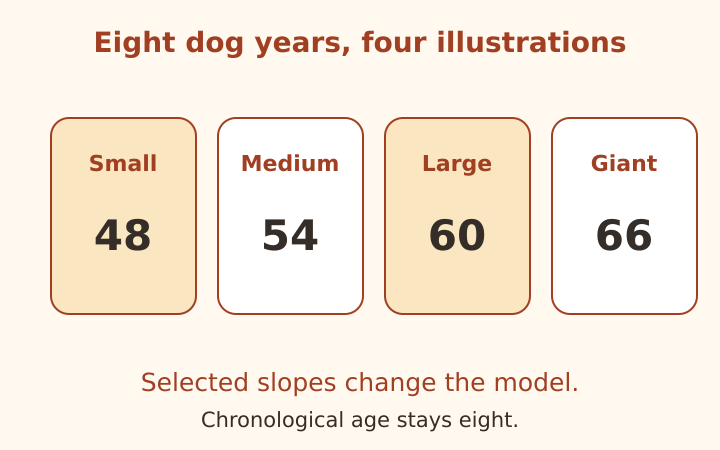
Selecting Giant instead of Small at dog age eight changes the illustration from 48 to 66. That is 24 plus six years times the chosen slope of four or seven. The difference is substantial because the slopes are applied repeatedly. It demonstrates model sensitivity, not proof that the individual’s equivalent age has suddenly changed when a dropdown is edited.
Keep estimated birthdays visibly estimated
A rescue record might give an approximate age or a provisional birthday. Entering that date can help organize a note, but the result should preserve its uncertainty. The tool cannot determine chronological age from appearance or choose between conflicting records. More detailed calendar output does not improve the underlying evidence about when the dog was born.
If you use years and months rather than dates, enter completed years and additional months. Five years and twelve months is not accepted as a valid component pair; enter six years and zero months. This validation catches an ambiguous representation rather than silently normalizing a field that may have been entered incorrectly.
The puppy calendar-age guide explains leap days, month ends and date uncertainty. Its conventions are record-keeping choices, not official rules for development, registration or eligibility. Keep the date basis beside the result whenever another reader might use a different convention.
Do not infer care needs from a human-year equivalent
An illustrative number cannot diagnose health, decide treatment or establish a clinical senior threshold. A dog is not automatically in a particular clinical stage because the display resembles a human retirement age. The calculator does not evaluate behavior, examination findings, medical history or individual development.
Age context can be discussed with a veterinarian, but it is not a replacement for that conversation. Avoid using a calculated number to dismiss a concern or to justify a treatment change. PawAgeCalc provides no care schedule and no assessment that a dog is healthy or unwell. Its human-year comparison is optional explanatory language attached to chronological inputs.
A displayed difference between size groups also should not be interpreted as a measured health difference between two dogs. The model changes only a chosen slope. Comparing individuals clinically requires context beyond the fields available here. Keep the comparison descriptive and avoid turning the chart into a ranking of wellbeing.
Read lifespan statistics without inventing a countdown
Population life expectancy and an individual’s remaining lifespan are different quantities. A published median or average describes a defined population under a study’s methods. It is not a deadline attached to every member, and it does not become an individualized prognosis when a birthday is subtracted from it.
This distinction matters for the search phrase dog life expectancy by breed. A responsible article can explain what a statistic means without offering a false remaining-years field. The calculator deliberately does not supply that field. Its age range through thirty years is a software limit, not a forecast that a dog will reach that age.
Use the size-based dog age calculator with assumptions stated plainly, then copy the note rather than only the converted number. Informational only, not veterinary advice. A useful result tells you how the illustration was made and preserves the individual questions that need qualified assessment.
Frequently asked questions
Does the calculator know a breed’s lifespan?
No. It has no breed-lifespan database and does not predict remaining life. Broad size groups are model assumptions.
Should I use a puppy’s current weight?
The group represents expected adult size, not current puppy weight. Choose Unknown when the adult group is uncertain.
Keep age and assumptions together
Open the dog age calculator to make an age note with the entry method and adult-size assumption visible. The human-year comparison is illustrative only, not veterinary advice, a health assessment or a prediction of remaining lifespan.
More notes from the setup desk
Dog Age Chart: Five Clear Worked Examples
Follow five original age examples, including size comparisons, fractional ages, puppy dates and clearly labeled model extrapolation.
Read the note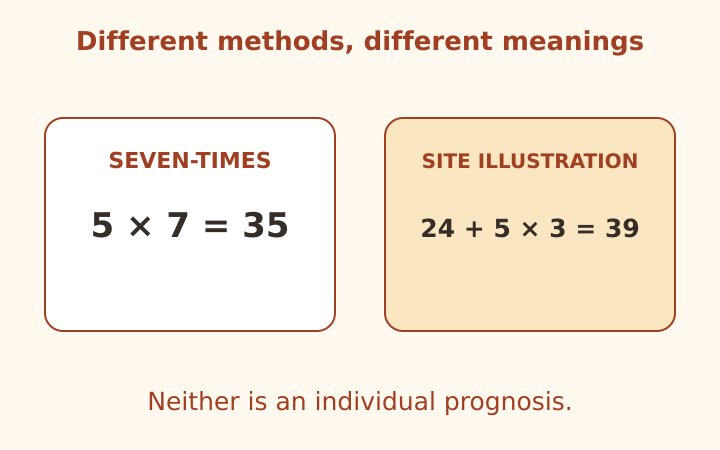
Dog Years to Human Years: Methods Compared
Compare the seven-times rule, a staged illustration and research context while keeping chronological age separate from prognosis.
Read the note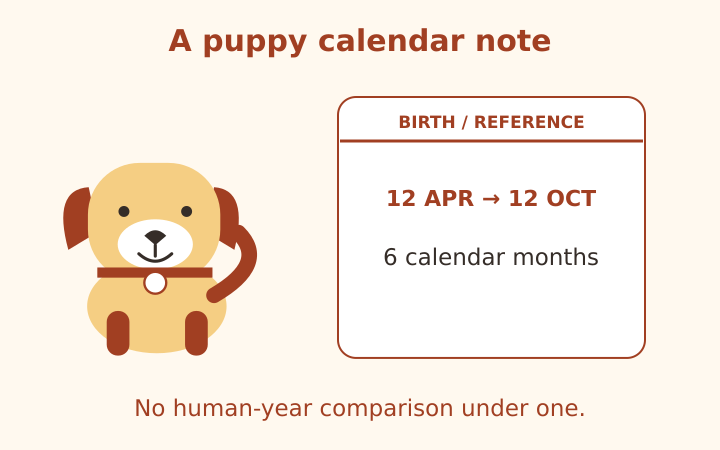
Puppy Age Calculator: Calendar Age Explained
Understand puppy calendar age, estimated birthdays, weeks versus months and leap-day conventions without a human-age assessment.
Read the note