Dog Age Chart: Five Clear Worked Examples
Follow five original age examples, including size comparisons, fractional ages, puppy dates and clearly labeled model extrapolation.
Read the noteUse the dog age calculator to read chronological age and an illustrative human-year comparison. Keep the date basis and adult-size assumption beside the number.

Informational only, not veterinary advice. No health assessment or lifespan prediction.
Try the fictional five-year medium-size example, then choose your age basis and expected adult-size assumption.
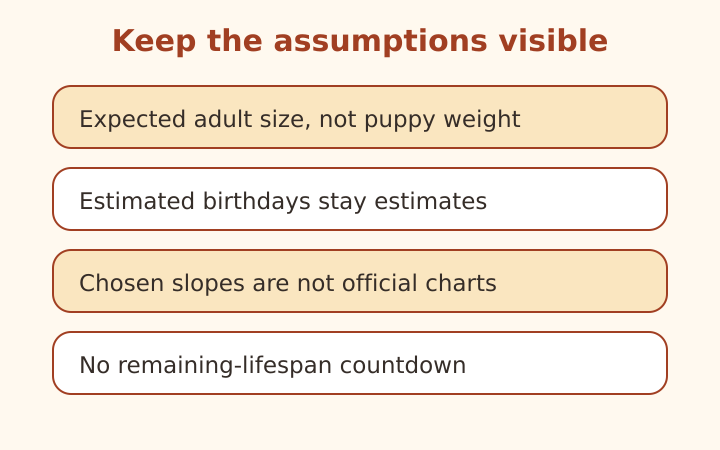
Enter completed years and months, or a birthday and reference date. Estimated birthdays stay estimates.
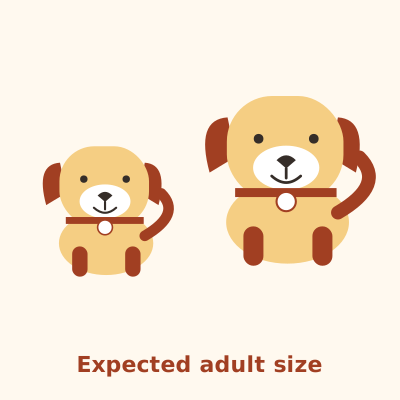
Use expected adult size or a clearly labeled unknown/medium assumption. The tool does not guess a breed.
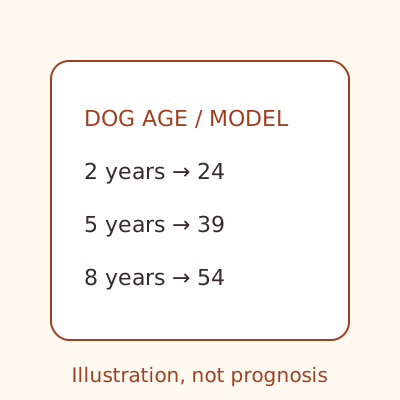
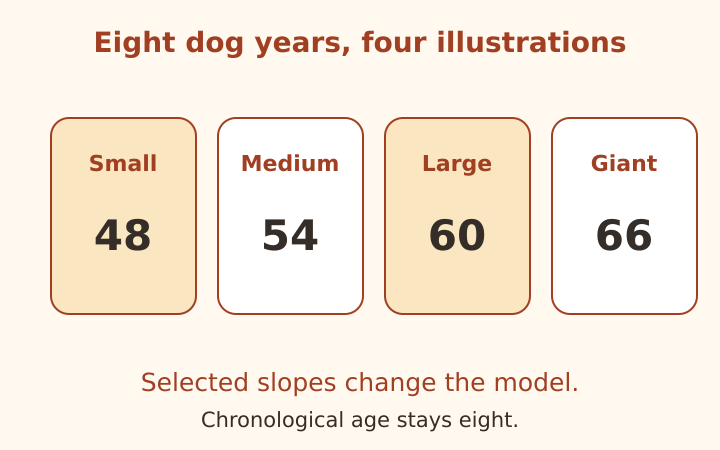
Read the staged formula, compare four illustrative slopes and expand the selected-size chart.
Keep dates, assumptions and limits together. Calculations stay in the browser, with manual-copy fallback.
Use the best birthday record you have, or completed years and additional months. Label any estimate.
Choose expected adult size. Unknown uses a visible medium assumption rather than an inferred breed.
Copy chronological age and model context. A converted number is not a clinical stage, health assessment or prognosis.
Calculate elapsed calendar age as of a chosen date, with a stated leap-day convention.
Keep the original uncertainty visible instead of treating decimal output as biological precision.
Inspect what a size slope changes. Human-year language remains an illustration, separate from veterinary care.
Chronological age from years/months or calendar dates, plus an illustrative human-year comparison from a visible adult-size model for ages one and above.
No. The size groups, interpolation and post-two-year slopes are this site’s illustration. The result does not diagnose health, assign a clinical stage or predict lifespan.
The tool deliberately omits human-year comparisons under one dog year. It still shows elapsed age. The boundary is a model-display choice, not a clinical developmental rule.
No. The fields remain in browser memory without upload, calculation cookies or history. Copy sends a note to your device clipboard.

Follow five original age examples, including size comparisons, fractional ages, puppy dates and clearly labeled model extrapolation.
Read the note

Check adult-size assumptions, estimated birthdays and chart claims. Learn why breed longevity statistics are not individual countdowns.
Read the note
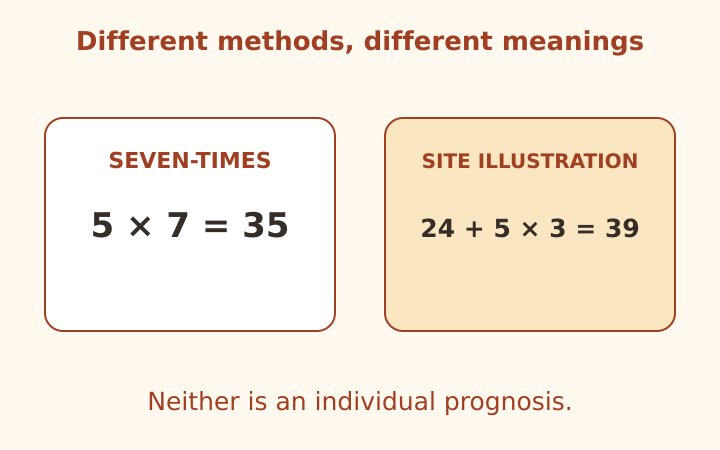
Compare the seven-times rule, a staged illustration and research context while keeping chronological age separate from prognosis.
Read the noteStart with chronological age. Keep the model assumptions visible and individual care questions with your veterinarian.